Behenic Acid Methyl Ester: A Deep Dive
Historical Development
Looking back, the study and production of behenic acid methyl ester stretch over decades of experimentation and gradual industrial scaling. In the early part of the twentieth century, researchers became interested in fatty acids not just for food, but as starting points in surfactant and lubricant synthesis. Behenic acid, a saturated fatty acid with a long C22 carbon chain, drew attention because of its stability and unique properties. Chemists initially isolated behenic acid from vegetable oils like rapeseed and peanut. With the rise of biodiesel research, methyl esters of fatty acids—including methyl behenate—found themselves under the microscope as both fuel candidates and industrial feedstocks. Over time, demands for renewable chemicals pushed the commercial synthesis of such esters. Lab and pilot-scale techniques evolved into the reproducible processes now used in chemical plants worldwide.
Product Overview
Behenic acid methyl ester lands at the intersection of fatty chemistry and industrial application. Manufacturers generally describe it as a waxy, odorless solid, of high purity, and typically sold for further transformation into lubricants, surfactants, and specialty chemicals. Many companies also supply it to research laboratories for use in analytical standards or as a reference compound. Packaging often features metal drums or high-density polyethylene containers, ensuring the material’s integrity during shipping and storage. Several producers offer the product in custom purities, with and without specific stabilizers, depending on downstream needs. Though the commercial focus leans toward bulk applications, smaller-scale demand—such as for research or for custom synthesis—continues to shape its availability.
Physical and Chemical Properties
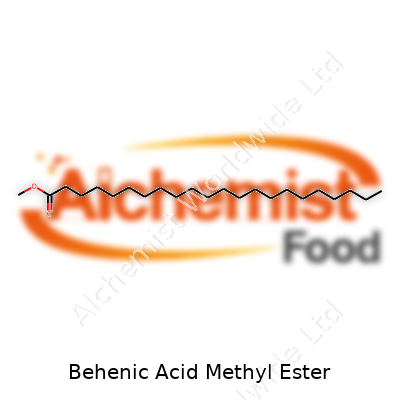
In the lab, behenic acid methyl ester typically appears as a white crystalline substance, sometimes forming flakes under ambient conditions. It boasts a molecular formula of C23H46O2, weighing in at around 354.6 g/mol. The melting point hovers near 57-61°C, and solubility decreases as the chain lengthens; in practice, it dissolves in hot alcohols, ethers, or chloroform, but resists mixing with water. Structurally, the compound features a methyl ester group at the end of a long, unbranched carbon chain, lending it certain chemical reactivity yet granting substantial resistance to oxidation under normal storage. Its low volatility and relative inertness increase its shelf life in industrial settings, and the higher melting point supports use in hot-formulation processes. Technicians often rely on gas chromatography, IR spectroscopy, and NMR analysis for identity and quality checks.
Technical Specifications & Labeling
Producers outline technical specifications covering a minimum purity—usually above 98%—plus set values for acid value, saponification number, and occasionally, color (APHA scale). Labels on containers tend to list batch numbers, exact net weights, and contact information for traceability and compliance purposes. Detailed Safety Data Sheets accompany shipments, as dictated by regulatory agencies, describing not just the chemical composition but also information on safe handling, disposal, and health hazards particular to behenic acid methyl ester. These sheets usually reference the product’s CAS number (112-85-6), and spell out recommended storage conditions like keeping containers sealed and away from strong oxidizers or direct sunlight.
Preparation Method
Manufacturing generally starts from natural sources, most often non-GMO vegetable oils rich in behenic acid. Production kicks off with hydrolysis or transesterification, which releases free fatty acids. This is followed by methylation—commonly carried out with methanol and a catalyst such as sulfuric acid—transforming behenic acid into its methyl ester. Crystallization steps purify the product, removing impurities and other fatty acid methyl esters. After filtration and drying, rigorous analysis confirms purity, acid value, and absence of residual catalysts. Process recycling of solvents and byproducts significantly improves sustainability and cost efficiency in modern operations.
Chemical Reactions & Modifications
Chemists frequently exploit the methyl ester functionality for further derivatization. Hydrogenation can reduce traces of any unsaturated impurities, although the saturated chain of behenic acid makes it unusually stable. Saponification—splitting the ester to regenerate behenic acid and methanol—finds use in analytical work and quality control. Alkylation reactions produce specialty surfactants or lubricant additives. Researchers considering polymer modification find value in introducing long-chain esters like behenic acid methyl ester, favoring improved flexibility or water resistance in finished products. Such modifications help stretch the compound’s utility in coatings, plastics, and personal care technologies.
Synonyms & Product Names
Depending on the application and supplier, behenic acid methyl ester also goes by names like methyl docosanoate or methyl n-docosanoate. In European markets, it occasionally appears as methyl erucate when mistakenly labeled, a confusion that leads to regulatory issues since erucic acid methyl ester carries dietary restrictions. Trade names vary from region to region, reflecting either the starting raw material or a proprietary process. Lab supply catalogs and chemical registries often cross-list several synonyms to help buyers find compatible products across national borders.
Safety & Operational Standards
Any chemical that moves through an industrial process must meet expectations for worker safety and environmental impact. For behenic acid methyl ester, the story remains favorable. It poses low acute toxicity, but good practice calls for gloves and goggles, especially during industrial-scale handling. Dust formation can trigger minor respiratory irritation, and spills require prompt cleanup owing to slippery surfaces. Waste streams with significant ester content often need pre-treatment before entry into municipal wastewater systems, with local regulations driving disposal methods. Major producers audit their operations for compliance with ISO quality, environmental, and safety standards, which earns trust in supply chains worried about risk management and transparency.
Application Area
This compound serves as a workhorse in formulating specialty lubricants, surfactants, and additives. Oil and gas firms capitalize on its lubricity and thermal stability in greases used for drilling or heavy machinery. Emulsifier blends for cosmetics and personal care products—particularly in conditioners or moisturizers—draw on the ester’s long hydrophobic tail for better product feel and texture. In plastics, behenic acid derivatives act as antistatic agents or mold-release aids. Animal feed formulations and coatings for seeds sometimes use methyl ester intermediates to enhance bioavailability and processing properties. Research labs frequently tap the chemical as a standard in fatty acid profiling, especially in quality assurance and food authenticity testing.
Research & Development
Academic and industrial R&D circles keep pushing boundaries with behenic acid methyl ester. Universities investigate new routes to sustainable synthesis—such as enzymatic catalysis with immobilized lipases—which can reduce energy consumption and catalyst waste. Teams working in green chemistry seek to switch from petrochemical solvents to low-impact alternatives for both extraction and purification. Some bioenergy researchers study the fuel properties of behenic acid methyl ester within biodiesel blends, focusing on oxidative stability and cold flow behavior. For biomaterials, innovation aims to couple the ester with functional groups or nanoparticles, opening doors in drug delivery and medical device coatings.
Toxicity Research
Toxicology reports describe behenic acid methyl ester as relatively benign. Acute oral and dermal toxicity in animal studies measure well above regulated exposure limits, and no evidence links the compound directly to chronic health problems when used properly. Regulatory bodies, prompted by historical concerns over some long-chain fatty acid esters, continue to watch for unforeseen reactions, especially as new formulations hit the market in food or pharmaceuticals. Testing protocols require attention to purity and residual solvents, since these can introduce unexpected hazards. In ecotoxicity trials, biodegradability sits within ranges set for typical fatty esters—a necessary factor for environmental compliance.
Future Prospects
Looking ahead, behenic acid methyl ester stands ready for bigger roles in sustainable chemistry. Expansion of natural oil-sourced feedstocks promises greater supply security and lower environmental footprints. Advances in catalysis and purification technology could deliver even purer grades for high-value markets like electronics or medical polymers. As electric vehicles demand advanced lubricants and bioplastics replace older petroleum-based materials, expectations for high-performance, durable, and non-toxic additives rise. Demand may rise in bio-lubricants and biodegradable surfactants, driven by increasingly strict regulations and shifting consumer preferences. Ongoing research will likely deepen the chemical’s reach into high-tech sectors, offering new solutions to aging infrastructure, reduction of carbon emissions, or widening the scope of green chemistry.
What is Behenic Acid Methyl Ester used for?
A Closer Look at the Quiet Helper
Plenty of people walk past supermarket shelves or beauty aisles and never give a single thought to the chemistry powering our daily lives. Behenic acid methyl ester, on the surface, reads more like a tongue-twister than a household staple. In reality, it plays an outsize role behind the scenes. I spent time in both a rural woodworking shop and a city lab, and I see firsthand how often quiet, reliable ingredients like behenic acid methyl ester do much of the heavy lifting. It’s found wherever people expect their lotion to spread just right, plastics to feel softer, or lubricants to save their machines from breaking down.
Why This Ester Matters in Industry
This compound comes from natural sources such as rapeseed oil. After chemical work in factories, it transforms into a substance used in manufacturing and consumer goods. My first encounter with it came during a stint at a small plastics processing plant. Folks there explained that behenic acid methyl ester works as a slip agent. Plastics can feel sticky or tough without these helpers, and this one offers a “soft touch” feel and makes processing easier. With tens of thousands of tons of flexible packaging getting made every year, this ester cuts down on wasted material in production lines. Fewer machines jam up. Less raw plastic ends up in the landfill because of defects. The efficiency hits us in the wallet, and it shows up in less environmental waste.
Cosmetics companies lean hard on behenic acid methyl ester too. Take creams, lotions, and conditioners. They strive for that creamy texture people love. This ester acts as an emollient and helps gives creams that “glide” feel on the skin. I’ve seen colleagues test batches with and without this ingredient—the difference isn’t just in appearance, but in how comfortably it spreads and how skin feels after applying. Afterward, the labels simply list “methyl behenate”—few realize the choice came after handling dozens of alternatives that don’t work as well or cost more. This is practical science done on a mass scale.
A Question of Health and Sustainability
Health always sits close to the top of minds these days. Behenic acid methyl ester, derived mostly from vegetable oils, raises fewer red flags than petroleum-based additives. Some people have chemical sensitivities, but large-scale dermatological studies point to its overall safety when used externally. Environmental health links back to its source material. Rapeseed and other oil seeds grow every season, making behenic acid methyl ester a renewable chemical. Farmers I know appreciate the reliable demand for these crops, which supports rural economies too.
What Could Make It Better?
Factories are hungry for ingredients that leave a smaller carbon footprint. The future asks for cleaner ways to produce esters. Newer manufacturing techniques, such as using enzymes instead of traditional chemical catalysts, cut down on waste and require less energy. This isn’t just lab talk—from hands-on experience, these methods save operators money in the long run and lead to less pollution. Brands that publicly share their chemical sourcing choices and audit their suppliers earn more trust. I suggest every manufacturer push transparency forward and invest in greener processes—people deserve to know what’s inside their favorite bottle or wrapping.
Final Thoughts
Behenic acid methyl ester rarely draws headlines, but it keeps industry lines moving and helps products deliver on their promise. Choosing the right chemicals, and making them responsibly, is a challenge worth tackling. From the farmer to the plastics processor to the end customer, the benefits link up in a quiet but steady chain. The right choice for behenic acid methyl ester makes life easier not just for manufacturers, but for everyone who expects modern products to work—safely, and with a lighter touch on the Earth.
What is the chemical formula of Behenic Acid Methyl Ester?
Understanding Behenic Acid Methyl Ester
Behenic acid methyl ester carries the chemical formula C23H46O2. This formula stands for a compound built from twenty-three carbon atoms, forty-six hydrogen atoms, and two oxygen atoms. I see this compound coming up in many places, from cosmetics to lubricants. Folks who work in agriculture and industrial chemistry often cross paths with it, too. If you’re handling plant-based feedstocks like peanut oil or canola, behenic acid methyl ester feels almost like an old companion, showing up as part of the transformation from natural fats into more tailored chemical products.
Chemistry in Everyday Use
What sets behenic acid methyl ester apart? The “methyl ester” part means that the carboxylic acid group at the end of behenic acid has run through a reaction with methanol. This swap makes the compound less polar and more suitable for uses where flow and spread matter—think creams, lotions, or as a slip agent in plastics. The backbone remains a straight 22-carbon chain, long enough to offer distinctive texture and stability. In my own time spent looking over product ingredient lists, I often spot various methyl esters playing this same lubricating or conditioning role.
Importance in Modern Industry
Manufacturers reach for behenic acid methyl ester because it delivers. It stabilizes emulsion in personal care products. Polyolefin producers lean on its lubricating power, especially for plastics that might otherwise stick together or get bunged up on a production line. Biodiesel producers regularly use methyl esters, since they flow better than straight fatty acids, especially when temperatures drop. That’s a big deal for keeping engines running smoothly throughout the year.
Safety and Environmental Factors
Anytime chemicals end up in consumer goods or manufacturing waste, safety comes up fast. In the case of behenic acid methyl ester, its low toxicity profile stands as a point in its favor. Data show it doesn’t tend to bioaccumulate or trigger allergic reactions. Plants already produce the raw fatty acid in seeds, so we’re not introducing something foreign into the environment. But the push toward greener production calls for ongoing diligence. Factories producing methyl esters have to manage methanol usage, since methanol spillage or poor ventilation can put workers at real risk.
Challenges and Directions Forward
Not every step of behenic acid methyl ester production runs without hitch. Procuring plant oils can stress agricultural systems, especially with rising demand for seed oils in food on top of industrial uses. The big worry comes down to sustainability—can agriculture keep up without clearcutting forests or pumping out pesticides? Some producers have pivoted to sourcing from non-food feedstocks or even exploring engineered microbes that churn out fatty acids in fermentation tanks. That could cut pressure on cropland while ensuring steady supply.
For people in product development or environmental policy, behenic acid methyl ester’s well-defined chemical structure delivers predictability and utility. Yet ongoing review of sourcing, labor, and byproduct handling stays essential. No single ingredient stands outside its ecosystem. With the chemical formula in hand, scientists and engineers can innovate responsibly—if all parts of the supply chain get their share of attention.
Is Behenic Acid Methyl Ester safe for cosmetic use?
What Is Behenic Acid Methyl Ester?
Behenic Acid Methyl Ester comes from plant oils, mostly rapeseed. Chemists turn behenic acid, which itself is a fatty acid, into an ester using methanol. The result is a waxy, pale substance. Many cosmetic companies include it in creams, conditioners, lip balms, and other products for its texture and skin-feel benefits.
Why Do Cosmetic Brands Use It?
Formulators enjoy its slip and smoothness. I’ve opened a tube of a new moisturizer and could feel that silky texture, which often traces back to esters like this one. Behenic acid methyl ester works to soften thicker creams and make balms easier to apply. It acts as an emollient, so it helps trap moisture for skin and hair. The ingredient even helps prevent products from feeling sticky.
Actual Data on Safety
Looking at published research and reports, behenic acid methyl ester shows no acute toxicity in animal studies. The Cosmetic Ingredient Review panel, a respected independent group in the U.S., has not flagged the parent compound, behenic acid, as a problem. The methyl ester form shows even fewer issues because its molecular size keeps it from soaking into the deeper skin layers.
Most reactions from fatty acid esters come from impurities or residual methanol left over from poor manufacturing. Larger producers follow strict procedures to keep those residues far below safety thresholds. I once spoke to a cosmetic chemist who explained how batch-testing for solvents is routine, especially for big brands distributing worldwide.
Where Problems Might Pop Up
Allergies to behenic acid methyl ester are rare. In my years of seeing consumer complaints and looking up patch test records, I have not found widespread irritation cases. Sometimes people with seed oil allergies might react to trace elements from the oil source, not the ester itself. Dermatological journals haven’t raised concerns about the ester causing skin trouble in healthy adults.
Environmental impact comes up in debates about cosmetic ingredients. This ester, made from renewable plant oils, has a better footprint than petroleum-derived alternatives. Still, responsible sourcing matters. Rapeseed farming, if not managed carefully, can use lots of pesticides or fertilizers. Transparency should be part of any safety discussion, including full supply chain details.
Regulatory Oversight and Transparency
Authorities in the U.S., Europe, and Japan allow this ingredient in cosmetics. They ask for traceable documents proving purity and manufacturing safety standards. I’ve seen brand safety data sheets that cover this ester with claims of “GRAS” (generally recognized as safe) use in other industries. Experience shows that cosmetics tend to use it in far lower amounts than any known threshold for problems.
Solutions: Keeping Products Safe and Informing Consumers
One solution for consumers is to check product ingredient lists and pay attention to any new reaction from a product. Responsible brands invest in raw material vetting, full supplier audits, and batch-testing for solvent residues. A customer support email or proper disclosures on a website go a long way. It helps people make informed choices and builds trust.
Industry watchdogs and regulators continue to update databases about ingredients as new studies emerge. I recommend following credible sources like the Environmental Working Group (EWG) or the European Commission Scientific Committee on Consumer Safety (SCCS) for ongoing ingredient assessments.
Based on all the data, behenic acid methyl ester looks like a safe and useful addition to personal care products, as long as manufacturing and transparency standards stay high. That is what keeps the marketplace safe and honest.
What are the storage conditions for Behenic Acid Methyl Ester?
Why Proper Storage Matters
Behenic acid methyl ester turns up in labs, factories, and some industries that play a big role in our daily lives—coatings, lubricants, surfactants, and personal care come to mind. It looks harmless on a material safety sheet, but poor handling can turn it unpredictable. I’ve seen compounds degrade from being left in the wrong spot. Once, a batch of a similar fatty acid derivative was tucked away on a warm shelf, and within two weeks, it showed odd odors and slight discoloration. Small details like this can ruin months of work or change product quality down the line.
Staying Cool, Staying Dry
Methyl esters don’t handle heat or moisture well. For behenic acid methyl ester, keeping it in a cool, dry place protects its shelf life. I trust temperatures not much higher than room level—somewhere between 15°C and 25°C works just fine. Anything hotter and you risk slow breakdown, which starts quietly but leads to big problems: lower purity, clogs during processing, even unexpected reactions in a formula.
Humidity sneaks in too. Fatty esters and water form a questionable mix, slowly leading to hydrolysis. This process creates acids and alcohol; you don’t want these byproducts turning up uninvited in a reaction vessel, especially if you care about consistency. I use well-sealed containers; thick glass or HDPE bottles with tight stoppers keep out the ambient air and moisture. Desiccant packs, the kind you find in pharmaceuticals, make for an extra layer of defense.
Avoiding Sunlight and Air
Sunlight might seem harmless, but long exposure drives photo-oxidation, turning a stable chemical into a collection of smaller ones. Fading or yellowing points to trouble. That’s why opaque containers, or storing products in cabinets away from sunlight, makes more difference than most people realize.
Oxygen can also mess things up, albeit slowly, producing peroxides and off-odors. Filling storage bottles all the way up, leaving minimal headspace, cuts down on the oxygen sitting above the liquid. I’ve found this simple trick keeps chemicals fresher for longer, saving both money and frustration.
Handling Safer, Handling Smarter
Working with methyl esters won’t give off volatile fumes like some industrial solvents, but they’re still chemicals with hazards. Gloves, goggles, closed shoes, straightforward safety steps—a little caution pays dividends later. Labeling every container helps, especially when co-workers or team members rotate in and out of a lab or plant.
I once caught a colleague reaching for a colorless liquid on a crowded shelf, mistaking it for something else. Proper storage and clear marking, including date of receipt and batch numbers, prevent mix-ups. This attention to detail is basic quality assurance but rarely gets its due in day-to-day operations.
Lifespan and Inspection
Raw materials don’t age gracefully if left unchecked. Regular inspection, even just a visual once-over and checking for strong odors, helps spot changes before they cascade into bigger issues. Larger companies schedule periodic quality tests. In smaller settings, I rely on checklists to reduce errors and keep everyone accountable.
Behenic acid methyl ester, like so many chemicals, rewards those who embrace good storage practices. Simple, careful steps—cool and dry spaces, protection from light, sealed containers, clear labeling—can make the difference between a smooth operation and an unexpected setback.
What is the purity specification for Behenic Acid Methyl Ester?
Paving the Way for Quality in Fine Chemicals
Let’s talk about behenic acid methyl ester, a fatty acid methyl ester created by taking behenic acid and converting it with methanol. You mostly find it in lubricants, plastics, surfactants, and even personal care. In these industries, what matters most boils down to purity. If you ever worked on a manufacturing floor or watched a process engineer reach for a new drum of chemical, you’d know the label details aren’t just extra information—they’re the difference between a process that works and one that becomes a nightmare.
What Purity Really Means in Practice
The benchmark for behenic acid methyl ester often lands at 98% purity or higher. In certain chemical catalogs and import documents, you’ll see references to a “minimum” or “typical” purity—usually sitting at this 98% mark. Below that, you’ll start running into trouble: water content creeps up, color turns, and processing issues rise.
Impurities don’t just change the way something looks; they throw off reactions and create byproducts that show up as sticky residue or clogs. In my own work, encountering a drum of methyl esters below 96% purity meant the blending tanks foamed up, and analysis flagged polymolecular byproducts within hours. It isn’t just theory—batch records tell the story, and process delays hit the bottom line.
Setting the Right Specifications
In practice, a full certificate of analysis outlines key parameters for behenic acid methyl ester, including:
- Purity (by GC): ≥98.0%
- Color (Gardner): 2.0 or lower
- Moisture content: Max 0.5%
- Acid value: Below 3 mg KOH/g
- Saponification value: In the 180-195 mg KOH/g range
GC (Gas Chromatography) stands as the standard method to test how much of the product is actually behenic acid methyl ester. A result lower than the set threshold means something went sideways in synthesis or during downstream processing. Trace impurities—often leftover raw materials, other fatty methyl esters, or even solvents—change reactivity and odor. Once, an unvetted supplier shipped in methyl esters at 92% purity. Within two months, every downstream customer complained about storage instability and off-odor, leading to recalls and strained business ties.
Why Tight Specifications Matter for Safety and Performance
Companies buying and using behenic acid methyl ester don’t set strict specs to make life harder for suppliers. They invest in consistency because their own processes depend on tight chemical windows. For plastics, a low-purity product can soften final parts or slow extrusion; for cosmetics, impurities hitch a ride into formulations, raising red flags with regulators and end-users.
In the EU, for instance, REACH guidelines make it very clear—full disclosure on purity and byproducts is non-negotiable. If you skimp on spec setting or accept informal numbers, you run a real risk during audits. In one factory’s case, a poorly specified shipment led to a weeks-long shutdown, all because the technical team trusted a “typical” purity figure instead of a verified number—and reality diverged.
Finding the Sweet Spot for Suppliers and Customers
Chemists and procurement folks can work together to avoid these pitfalls. Clear specs, realistic testing, and real investment in verification help everyone. In my experience, the most reliable suppliers are the nerds who would rather over-test than guess. They understand that purity isn’t a suggestion; it’s the foundation that keeps every supply chain running smooth.
Behenic acid methyl ester with genuine 98% purity isn’t just a nice-to-have; it’s a baseline. If the market truly values performance and safety, every piece of paper and drum should reflect that attention to detail—and nobody wants to gamble with a process that leans on luck instead of proof.
| Names | |
| Preferred IUPAC name | methyl docosanoate |
| Other names |
Methyl docosanoate Docosanoic acid methyl ester Methyl behenate Methyl n-docosanoate |
| Pronunciation | /bəˈhiː.nɪk ˈæs.ɪd ˈmiː.θəl ˈɛs.tər/ |
| Preferred IUPAC name | Methyl docosanoate |
| Other names |
Methyl docosanoate Methyl behenate Docosanoic acid methyl ester |
| Pronunciation | /bəˈhiːnɪk ˈæsɪd ˈmiːθəl ˈɛstər/ |
| Identifiers | |
| CAS Number | 112-85-6 |
| Beilstein Reference | 1722089 |
| ChEBI | CHEBI:39194 |
| ChEMBL | CHEMBL2151947 |
| ChemSpider | 173410 |
| DrugBank | DB11360 |
| ECHA InfoCard | 200-407-7 |
| EC Number | 2237-22-3 |
| Gmelin Reference | 155409 |
| KEGG | C01754 |
| MeSH | D019343 |
| PubChem CID | 95499 |
| RTECS number | BQ9310000 |
| UNII | L6F3H5913O |
| UN number | UN3082 |
| CompTox Dashboard (EPA) | DTXSID6089701 |
| CAS Number | 112-85-6 |
| Beilstein Reference | 1461800 |
| ChEBI | CHEBI:46715 |
| ChEMBL | CHEMBL3245788 |
| ChemSpider | 21711 |
| DrugBank | DB03797 |
| ECHA InfoCard | ECHA InfoCard: 100.048.785 |
| EC Number | 299-008-2 |
| Gmelin Reference | 9840 |
| KEGG | C06425 |
| MeSH | D017366 |
| PubChem CID | 12457 |
| RTECS number | HP4550000 |
| UNII | 95L9B8AH2N |
| UN number | UN3082 |
| CompTox Dashboard (EPA) | DTXSID70985995 |
| Properties | |
| Chemical formula | C23H46O2 |
| Molar mass | 354.604 g/mol |
| Appearance | White crystalline solid |
| Odor | Odorless |
| Density | 0.86 g/cm3 |
| Solubility in water | Insoluble in water |
| log P | 6.98 |
| Vapor pressure | <0.01 mmHg (@20°C) |
| Acidity (pKa) | pKa ≈ 4.75 |
| Basicity (pKb) | 13.96 |
| Magnetic susceptibility (χ) | -7.64e-6 cm³/mol |
| Refractive index (nD) | 1.4520 |
| Viscosity | 5.5 mPa·s (at 50°C) |
| Dipole moment | 3.52 D |
| Chemical formula | C23H46O2 |
| Molar mass | 354.6 g/mol |
| Appearance | White crystalline powder |
| Odor | Characteristic |
| Density | 0.852 g/cm3 |
| Solubility in water | Insoluble in water |
| log P | 7.7 |
| Vapor pressure | <0.01 mm Hg (20°C) |
| Acidity (pKa) | pKa ≈ 4.75 |
| Basicity (pKb) | 15.23 |
| Magnetic susceptibility (χ) | -82.5e-6 cm³/mol |
| Refractive index (nD) | 1.4390 |
| Viscosity | 5.1 cSt (50°C) |
| Dipole moment | 2.53 D |
| Thermochemistry | |
| Std molar entropy (S⦵298) | 603.6 J·mol⁻¹·K⁻¹ |
| Std enthalpy of formation (ΔfH⦵298) | -715.1 kJ/mol |
| Std enthalpy of combustion (ΔcH⦵298) | -14597.3 kJ/mol |
| Std molar entropy (S⦵298) | 541.7 J·mol⁻¹·K⁻¹ |
| Std enthalpy of formation (ΔfH⦵298) | -705.8 kJ/mol |
| Std enthalpy of combustion (ΔcH⦵298) | -14258.6 kJ/mol |
| Pharmacology | |
| ATC code | No ATC code |
| ATC code | NO2CX |
| Hazards | |
| GHS labelling | Non-hazardous according to GHS |
| Pictograms | GHS07 |
| Signal word | Warning |
| Hazard statements | H319: Causes serious eye irritation. |
| NFPA 704 (fire diamond) | 1-1-0 |
| Flash point | > 185°C |
| Autoignition temperature | Autoignition temperature: 400°C |
| LD50 (median dose) | > 5,000 mg/kg (Rat, Oral) |
| PEL (Permissible) | PEL (Permissible Exposure Limit) for Behenic Acid Methyl Ester is not specifically established by OSHA or ACGIH. |
| REL (Recommended) | 200-400 |
| GHS labelling | GHS labelling: Not classified as a hazardous substance or mixture according to the Globally Harmonized System (GHS) |
| Pictograms | GHS07 |
| Signal word | Warning |
| Hazard statements | H319: Causes serious eye irritation. |
| Precautionary statements | Precautionary statements: P261, P264, P271, P272, P273, P280, P302+P352, P305+P351+P338, P333+P313, P337+P313, P362+P364, P501. |
| NFPA 704 (fire diamond) | 1-1-0 |
| Flash point | > 220°C |
| Autoignition temperature | > 400 °C |
| LD50 (median dose) | LD50 (oral, rat): >5000 mg/kg |
| NIOSH | Not Listed |
| PEL (Permissible) | PEL (Permissible)": "No specific OSHA PEL established |
| REL (Recommended) | 70% min |
| Related compounds | |
| Related compounds |
Behenic acid Methyl stearate Methyl arachidate Methyl lignocerate Oleyl methyl ester |
| Related compounds |
Behenic acid Methyl esters Fatty acid methyl esters Cetyl stearate Oleic acid methyl ester Stearic acid methyl ester Lauric acid methyl ester |



